Search this question and you will find two camps. One says a personal website is essential. The other says it is a time sink, and that GitHub, LinkedIn and a blog do the same job. Both camps are partly right, because they are answering for different people.
This page does not take a side. It gives you a test with three questions, shows what to use if the answer is no, and describes the smallest site worth building if the answer is yes. It also names what we could not find: independent proof that a website raises your chances of anything. If you already know you want both a profile and a site, personal website vs LinkedIn shows how to split the work.
01Do you need a personal website? The three-question test
Answer yes or no to each question. Be honest about the third one, because it is where most people skip a step.
Do people need to judge your work before they hire or buy?
Designers, writers, consultants, coaches, authors, speakers and advisers are judged on what they have done and how they think. A site holds that evidence in one place you control.
Do you sell your own services or products?
If you are your own business, a search for your name should end on a page where a buyer can act. A profile on someone else's site rarely does that.
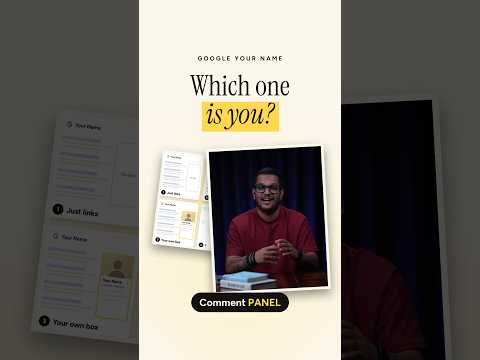
When you search your name in a private window, are you happy with what fills page one?
If page one is empty, full of other people with your name, or out of date, a domain in your name is the strongest page you can add.
| Yes answers | What it means | Suggested action |
|---|---|---|
| Zero | LinkedIn and your employer's pages are enough for now | Complete your profile; revisit if your situation changes |
| One | A small site would help | Build a one-page site and link it from LinkedIn |
| Two | A site is part of how you earn | Build a four-page site and keep it current |
| Three | A site is the page that decides what strangers see | Build it first, ahead of other profile work |
Our decision test
A few notes on reading the test. Question three is the one most people skip, and it is also the cheapest to answer. If your name is shared, our guide to ranking with a common name explains why a domain in your name matters more for you. If the third answer is a no because page one is empty rather than bad, you have more room, since there is nothing to outrank. The page-one look is covered in how to show up on Google for your name.
02What the evidence supports, and what it does not
A survey run by a domain company asked 121 hiring professionals about portfolios. 86 percent agreed or strongly agreed that they would visit a candidate's portfolio when offered one, and 71 percent agreed or strongly agreed that its quality would influence their decision. The writer who reported it admitted the sample was small and likely tilted to websites. Treat it as a hint about reviewers who look at work samples, not as a law.
The strongest case against comes from a developer who closed their own site. They argued it consumed hundreds of hours, that managers they cited liked sites but did not weigh them heavily, and that GitHub, LinkedIn and a blog on another platform did the job with less upkeep. The same writer allowed that freelancers, design-led roles and people with large audiences may still benefit. So even the sceptic's answer is the same test as ours.
03Are personal websites still relevant now that AI answers exist?
Yes, for a reason that is easy to miss. Google says AI Overviews and AI Mode use the same core ranking systems as the rest of Search, and that no special markup or AI file is needed. Ahrefs found that 37.9 percent of AI Overview citations come from pages in Google's top 10, 31.2 percent from positions 11 to 100 and 31.0 percent from beyond 100, in a study of 863,000 search results pages. Pages you control can be among those cited, and a clear page about you is the page that can be quoted accurately.
Ahrefs also reports that branded web mentions correlate 0.664 with AI Overview visibility in a study of 75,000 brands, the strongest factor it measured. A site does not create mentions by itself. It gives other people one clean address to mention and gives AI tools one page that states your facts the way you want them stated. It is a base, and it will not rank on its own.
04What can you use instead of a personal website?
If your test says no, or you are not ready, you have options. Each one covers some of what a site does and leaves a gap.
| Instead of a site | What it covers | What it leaves out |
|---|---|---|
| Complete LinkedIn profile | Being found, quick credibility | Control of layout, long work, owning the page |
| GitHub or similar code host | Proof for technical roles | Non-technical readers, a clear contact route |
| Blog on another platform | Writing, regular output | A page about you, your own domain |
| A company team page | Authority from your employer | It changes when you leave |
| A newsletter page | A growing audience you can reach | A neutral page for a stranger searching your name |
The common gap is control. All of these live on someone else's domain. If that matters to you, the answer to the headline question starts to lean yes.
05The smallest personal website worth building
If the test says yes, resist the urge to build something large. A site with four pages, kept current, beats a twelve-page site that looks abandoned. These are the pages and what each does.
- Home: your full name, what you do in one plain sentence, who you do it for, and one clear action.
- About: a real bio written for a stranger. Our guide with professional bio examples gives short and long versions. See also About me page SEO for how to word it so it matches the searches you want.
- Work or services: two or three examples with the situation, what you did and what happened.
- Contact: one email address or form, and a link to your LinkedIn profile.
What a personal site should not do
- Repeat your CV line by line, since the profile already does
- Hide your name, since the name is what people search
- Use a stock photo where a real photo of you should be
- Carry a blog you will not write in, because an empty news page looks abandoned
- Collect details you do not need, like a phone number or home address
A short, honest page that is current is the aim. Coaches and consultants who sell their own time can look at SEO for coaches for how to word the offer so the page also answers the searches a buyer makes.
06Privacy, cost and upkeep: the honest downsides
A site costs money for a domain and hosting, and time to keep current. We do not quote figures here because prices vary by provider and plan. A site also adds a page about you that strangers can read, so decide before publishing what you will share. A bio can say the city you work in without giving a home address; a contact form can replace a personal email.
As for whether a website can see your browsing history: a site you run only records what you choose to measure on it. A site you visit may use cookies and scripts to track activity on that site. How a browser limits tracking is covered in its privacy settings, and it is a separate matter from owning a site.
What a typical template gives you
- A pretty homepage with a stock photo
- A paragraph about passion
- No page title naming you
- No link to your other profiles
- No reason for Google to prefer it
What we build
- Your full name and field in the page title and heading
- A bio written from your facts, matched across every profile
- Links both ways between site and profile
- One clear action for the reader
- A short checklist for keeping it current
Build it now if
- You answered yes to two of the three questions
- Your name is shared or the results for it are poor
- You want one page that states your facts clearly
- You will keep it small and current
Wait if
- You are employed, not looking, and found by employer
- You will not maintain it
- You want it to bring clients on its own within days
Before you build
0 of 7 doneIf you want us to check what appears for your name before you decide, the personal brand audit does it, and personal website SEO services covers building the page. The general guide to this topic is personal SEO.
07If you are still on the fence: a thirty day trial
You do not have to decide in theory. Run a small trial and let the result tell you. The timeline below uses stages, not dates, so you can start whenever you like.
Baseline
Search your name in a private window. Write down what fills page one and what is missing.
One page
Publish a single page with your name, what you do, one example of work and one way to contact you.
Links
Add the page to your LinkedIn contact info and to any bio you control. Google finds pages through links from pages it already knows.
Check
Search again in a private window after a few weeks. If the page appears and a stranger could act on it, add the other three pages. If not, review the baseline and the links before concluding anything.
Scroll sideways to follow the stages.
If your only concern is how your LinkedIn profile appears, fix that first with the steps in LinkedIn profile not showing on Google. A site and a profile support each other, and the weaker one pulls the other down.
Keep a note of what you changed between checks. If the page shows up only after you added links, the lesson is that the page needed to be found, not rewritten. If it shows up and nobody acts on it, the lesson is that the words need work. Either result is more useful than another month of wondering, and the trial costs a domain and an evening.